What financial institutions should know and do to counter proliferation financing
Unofficial translation from the Vietnamese original.

Today, the failure of companies and corporations to disclose their ultimate business purpose in their records and documents, or even to describe their business activities in detail on their official websites, can readily be exploited for illegal purposes. One example is the proliferation of weapons of mass destruction (WMD) involving Mingzheng, a Hong Kong-based company that sent and received US dollar transfers on behalf of a foreign trade bank linked to Pyongyang's WMD programme. In 2017, the US Department of Justice (DOJ) filed a civil forfeiture complaint for USD 1.9 million connected to Mingzheng. The funds were held at six US financial institutions (FIs).
Unlike money laundering and terrorist financing, WMD proliferation financing is a more elusive challenge. This article describes the risks of WMD proliferation financing and the methods commonly used by the organisations and individuals involved, and offers some ideas on how FIs can contribute to the fight against the proliferation of WMD-related materials, components and technology.
WEAPONS OF MASS DESTRUCTION
There are three types of WMD: nuclear, biological and chemical weapons. Nuclear weapons are the most devastating in their capacity for large-scale destruction and killing. If a 10-kiloton nuclear bomb (equivalent to the bomb tested by the DPRK in 2013) were dropped on Washington, DC, a fireball with a radius of nearly 500 feet (about 152.4 m) would engulf the city. High radiation doses within a radius of nearly 1 km would cause the death of 50–90% of people without medical assistance (some of them within a few hours).
The Treaty on the Non-Proliferation of Nuclear Weapons (NPT) was signed in 1968. Under it, five states are recognised as possessing the nuclear arsenals that exist today: the United States, Russia, China, France and the United Kingdom. Most countries in the world have signed the Treaty. The Treaty was designed to limit the number of nuclear-weapon states to five, but India, Pakistan and Israel have never signed it and have continued their own nuclear weapons development programmes. The DPRK, formerly a party to the NPT, withdrew from the Treaty in 2003. It now has 20–30 nuclear warheads and enough nuclear material to build another 30–60 nuclear weapons. There are nearly 14,000 nuclear weapons in the world today. They are enough to destroy all life on the planet many times over, and more than 90% of them belong to the United States and Russia.
Chemical weapons include nerve agents, blister agents, choking agents, blood agents, etc. At present, a number of countries are suspected or confirmed to have chemical weapons development programmes. The Syrian government has been accused of using chlorine gas against its own citizens.
International law also prohibits biological weapons, but some countries are suspected of conducting research for biological warfare. Chemical and biological weapons are not as destructive as nuclear weapons, but they can cause long-lasting harm and painful death.
Non-state actors, such as terrorist organisations and individuals, may also use WMD, as in the case of the Aum Shinrikyo cult's use of sarin gas on the Tokyo subway, or the letters containing anthrax sent to United States senators.
COUNTERING WMD PROLIFERATION
Today, preventing the proliferation of WMD is not about how ready-made weapons might fall into the hands of proliferators. Rather, it is about finding ways to prevent the illicit acquisition of, and trade in, the components and materials that can be used to build weapons or the missiles used to deliver them. The challenge is that such components and materials include dual-use goods and technologies, which have both peaceful and military applications. The world's economies depend on these goods and technologies, and companies need to purchase them in a timely and efficient manner.
What are dual-use goods and technologies? For example, a triggered spark gap (a small, spool-shaped object) is indispensable in a lithotripter (a device that transmits electromagnetic shock waves through a water tank while the patient sits inside, breaking up stones so that they leave the body naturally). However, such devices meeting specific technical characteristics are also used to trigger the detonation of a nuclear device.
How can it be ensured that countries can trade in dual-use goods and technologies without creating “gaps” for WMD proliferation? The answer is export control.
There are four main multilateral export control regimes: the Australia Group (AG), the Nuclear Suppliers Group (NSG), the Missile Technology Control Regime (MTCR) and the Wassenaar Arrangement (WA). Each regime controls specific categories of goods and technologies, namely biological and chemical, nuclear, missile, and conventional weapons. All four regimes regularly update their lists of items that require additional attention in trade. Countries with advanced export control systems adopt these control lists and require licences for the export, import, transit, trans-shipment and brokering of such goods, and for other related activities. In practice, this means that a company wishing to sell its dual-use goods to another company abroad must first approach its government and obtain an export licence.
In addition, the sanctions resolutions of the United Nations (UN) Security Council and the legal systems of individual countries also help prevent organisations and individuals intending to proliferate WMD from doing so through the trade in dual-use goods.
HOW DOES PROLIFERATION FINANCING WORK?
The goal of WMD proliferators is to exploit loopholes in the law to obtain goods that can contribute to WMD programmes. Proliferation networks come in all sizes and forms. Buyers of dual-use goods may be directly linked to WMD-possessing states or may operate in illicit markets.
One standard technique commonly used by such organisations and individuals is to buy goods just below the control threshold. This means that, unless exporting companies are extremely vigilant, WMD proliferators avoid having to apply for an export licence and being subject to the oversight of government agencies.
Another method that WMD proliferators often use to avoid government oversight and licensing is to pretend that they are placing orders for a domestic company. In such cases, the supplying companies do not need to apply for a licence.
Proliferators make false declarations about the end use and end user, and always hide behind front and shell companies. They never state that they are buying components for the DPRK's nuclear programme, Iran's missile programme or Syria's chemical weapons stockpile. Typically, they may tell a supplier that they need the goods for scientific research or other peaceful purposes. In 2006, an Iranian company disguised as a scientific laboratory ordered sensitive biological research equipment from Norway. On closer examination, the Norwegian supplier determined that the equipment sought by the Iranians was technically far more advanced than what a civilian laboratory would need and did not match the usual layout of a laboratory.
Another method particularly favoured by the DPRK is the use of diplomatic cover for procurement and fund-raising related to nuclear proliferation. The 2019 report of the UN Panel of Experts on the DPRK noted a long-standing pattern of DPRK diplomats abroad acting as procurement agents for their country's WMD programmes and using their bank accounts in developing countries to pay for goods. Iran is also known to abuse state institutions to evade a range of sanctions. For example, officials of the Central Bank of Iran have assisted illicit networks operating on Iran's behalf.
Increasingly, shipping companies and vessels are being exploited to evade sanctions. For example, Iran and the DPRK falsify documents, reflag vessels and switch off automatic identification systems to avoid detection while transporting illicit cargo.
Large suppliers have the resources to implement effective internal compliance programmes that help them detect any suspicious orders. However, some companies, particularly smaller ones, lack the resources to invest in compliance and remain complacent about the issue. In some cases, supplier companies or individuals know exactly what they are doing but ignore the risks for the sake of profit. For example, the US-based company MKS Instruments shipped pressure transducers to its subsidiary in China after obtaining a valid US export licence, believing that the goods would be used in China, without knowing that the pressure transducers could be used in centrifuges to enrich uranium, producing nuclear fuel for nuclear weapons.
Proliferators need to pay for the items they buy and, in most cases, they must do so through the formal financial system, making FIs part of their proliferation schemes. For financial transactions supporting proliferation, they use front and shell companies, agents and brokers, and engage in complex schemes to conceal the true purpose of the transactions.
WHAT CAN FINANCIAL INSTITUTIONS DO?
Proliferation financing controls worldwide are currently at an early stage. Most governments and FIs underestimate proliferation financing controls or have an incomplete understanding of them. For them, implementing sanctions is equivalent to countering WMD proliferation financing. In reality, WMD proliferation risk extends beyond what sanctions cover. Sanctions are by design reactive, punishing and deterring known WMD proliferators. To be truly effective, financial controls must cast a wider net to stop anyone attempting to engage in illicit activity.
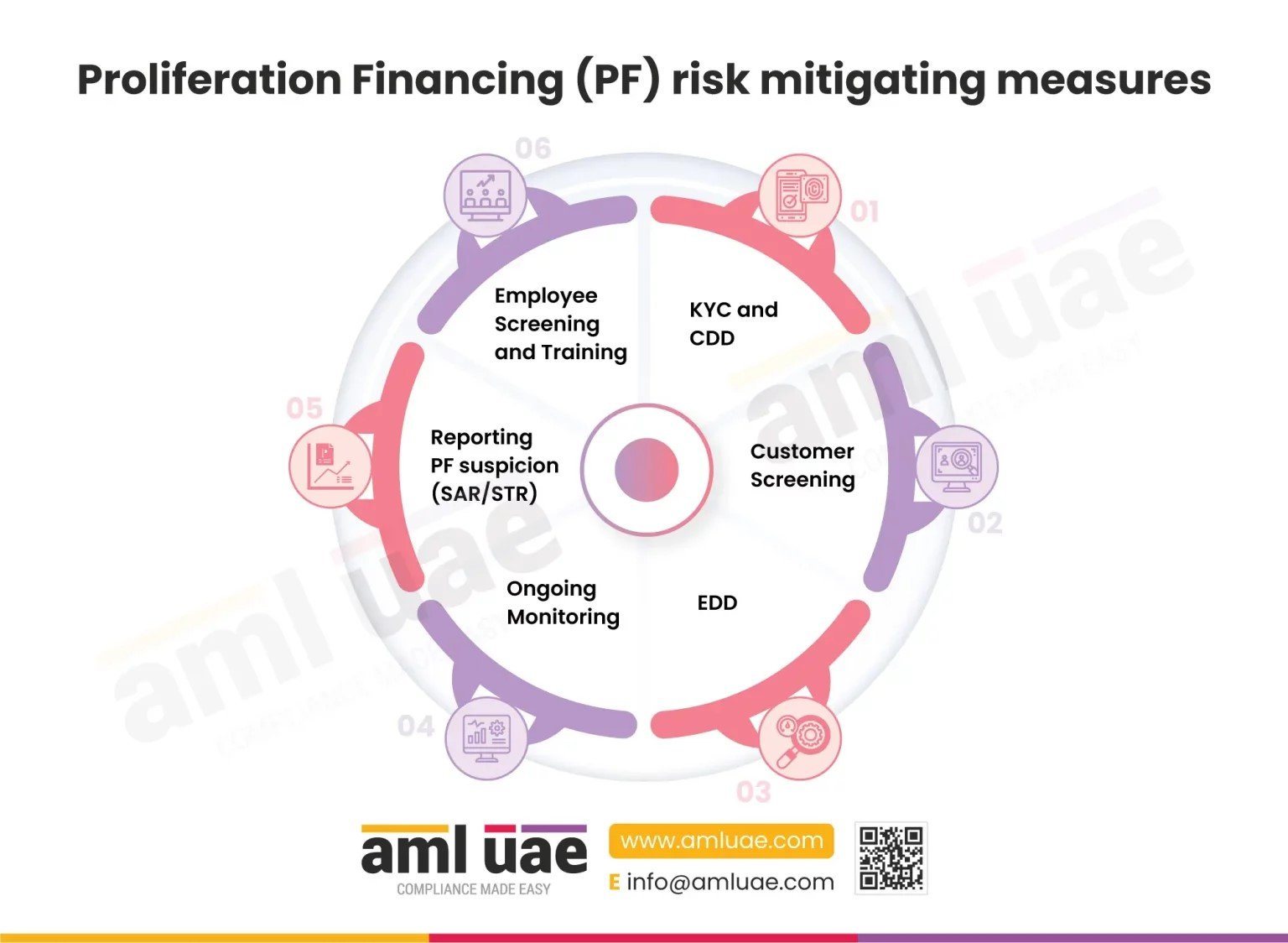
Measures to mitigate WMD proliferation financing risk
Even within the narrow task of implementing sanctions, FIs face many challenges. These include a large number of false positives when screening sanctions lists, the inability to identify proliferation-related transactions owing to a lack of information, and the capabilities and evasion techniques used by proliferators.
Essentially, therefore, FIs alone cannot prevent or detect proliferation financing risk. The main reason for this is the distance and weak connection between financial transactions and proliferation-related goods. Supplier companies know their products best, understand how they are used and can refuse to supply them to suspicious end users. They are the first line of defence against proliferation. Export and import licensing authorities are the second line of defence, as they can refuse to license goods leaving or entering the country. Finally, customs and border security officials are the third line of defence. They have access to the relevant documents (licences, descriptions of goods, bills of lading, etc.) and can physically inspect goods if necessary.
Nevertheless, FIs can and should play an important role in the fight against WMD proliferation. Below are some ideas on relatively easy steps that FIs can take to strengthen their capacity to implement controls against WMD proliferation financing, including by applying methods and techniques from export control.
FIRST LINE OF DEFENCE: INTEGRATING A PROLIFERATION FINANCING COMPONENT INTO KNOW-YOUR-CUSTOMER PROCEDURES
Financial institutions should start with a programme dedicated to countering WMD proliferation financing within their know-your-customer (KYC) procedures.
First, customer profiles should include information on the line of business and indicate whether the business involves dual-use goods. Government agencies responsible for trade, industry and export control can provide guidance to the financial sector on the companies involved in exporting or importing dual-use goods in a given country. More detailed information on the type and nature of the business can be requested directly from customers as part of the service process.
Second, as part of KYC, FIs should consider using data from more lists beyond the legally binding lists of their home jurisdiction. In the United States, the Bureau of Industry and Security provides lists of parties of concern, including the Denied Persons List, the Entity List, the Unverified List and the Consolidated Screening List. In Japan, the Ministry of Economy, Trade and Industry provides its industry with an “End User List”. Other countries develop their own lists. In addition to governments, international organisations and commercial providers also develop lists of parties suspected of involvement in WMD proliferation for export control compliance purposes. It should be noted, however, that adding more lists to screening software may increase the number of false positives.
Third, even scrutinising the physical addresses and telephone numbers provided when a customer is first onboarded can help detect “red flags” early. For example, it is not unusual for procurement agents acting on behalf of the DPRK to use addresses such as DPRK embassies or representative offices. In addition, DPRK front companies often share managers, owners and telephone numbers.
Fourth, in response to the pattern of DPRK diplomats and individuals holding DPRK diplomatic passports acting as procurement agents, FIs may consider introducing special procedures for DPRK nationals opening accounts. Such procedures could include confirming that DPRK diplomats are accredited to work in the country concerned, linking the duration of the account to the official accreditation period in that country, and ensuring that DPRK diplomats do not open multiple accounts in the names of their associates or front companies.
SECOND LINE OF DEFENCE: TRANSACTION MONITORING
Transaction monitoring should also incorporate a counter-proliferation financing component.
First, transactions involving the accounts of individuals and entities identified as sensitive should automatically receive greater ongoing scrutiny, for example DPRK diplomats; individuals possibly linked to designated activities; and businesses dealing in dual-use goods or commonly involved in proliferation financing, such as shipping companies, traders, exchangers, etc.
Second, great care is needed when screening the names of all parties to a transaction against such lists as part of the process. Screening against proliferation-related lists should be incorporated with due care when providing cross-border trade finance services.
Third, to help manage risk, customer profiles should be more comprehensive from the moment of onboarding, identifying customers that deal in dual-use goods. FIs should be alert to new or unusual transactions by such customers. Similarly, having a clear idea of a customer's line of business will alert FIs to inconsistent transactions (for example, a company with no connection to dual-use goods suddenly starting to conduct transactions involving them).
Fourth, FIs should adopt more appropriate controls for monitoring transactions involving dual-use goods. Currently, transaction monitoring involves manually reviewing all paper documents and screening the parties to a transaction using the selected solution (list-screening software). However, not all parties can be captured in the process, because their signatures are illegible or because they are not key parties to the transaction. Manual review of trade documents to identify the parties and goods involved appears insufficient to detect nuclear proliferation activity. Several emerging technical solutions may help in this regard. HSBC's pilot blockchain-based trade finance platform, Voltron, is designed to increase transparency and reduce transaction times. Although reducing transaction times may be the main commercial driver for such a platform, greater transparency across all parties in the supply chain would help FIs better understand the parties and goods involved. Another innovative approach that may be relevant involves collecting unstructured data, such as wire transfer data, transaction memos, case data, suspicious activity reports (SARs), adverse news, e-mail/telephone/chat content, law enforcement requests and trade documents. Proponents of this approach point out that such tools can help generate new insights into, and patterns of, potential illicit activity.
Fifth, geography should be built into transaction monitoring systems. For example, the US National Proliferation Financing Risk Assessment (NPFRA) notes that many DPRK front companies are based in China or use Chinese banks. Although setting alerts for an entire country (in this case China) may not be effective, FIs may consider applying closer scrutiny to transactions involving the specific cities and territories where DPRK agents tend to be most active. The NPFRA cites the cities of Dalian, Dandong, Jinzhou and Shenyang in Liaoning province, as well as Hong Kong, as examples. Similarly, FIs can create alerts for other “hotspots” based on available data on proliferation financing cases.
Sixth, filing SARs on any suspicious transactions can help uncover proliferation-related networks, even when FIs cannot determine whether the transactions are related to proliferation. This reduces the risk of proliferators concealing end users behind front companies and complex payment schemes.
Seventh, FIs should pay more attention to transactions related to the maritime shipping sector. For example, by providing letters of credit to trading networks that facilitated ship-to-ship transfers, FIs have unwittingly helped the DPRK evade sanctions. FIs may consider applying stricter due diligence procedures and tighter conditions to transactions involving shipping activities in high-risk situations.
Finally, FIs may consider amending trade finance service contracts to allow an institution to exit a transaction or relationship without penalty if the customer fails to identify transactions involving dual-use goods or if there are other concerns about the transaction.
CONCLUSION
The risk of WMD proliferation is growing and becoming more sophisticated, so FIs have a special responsibility in pursuing the common goal of preventing future nuclear, biological or chemical attacks. Proliferation financing risk is more difficult to grasp and address than money laundering and terrorist financing. Nevertheless, there are steps that FIs can take today to counter these risks.
References:
Thanh Tung – Centre 81