Vietnam Attends the Second Regular Meeting of the Board of Governors of the International Atomic Energy Agency (IAEA)
Unofficial translation from the Vietnamese original.
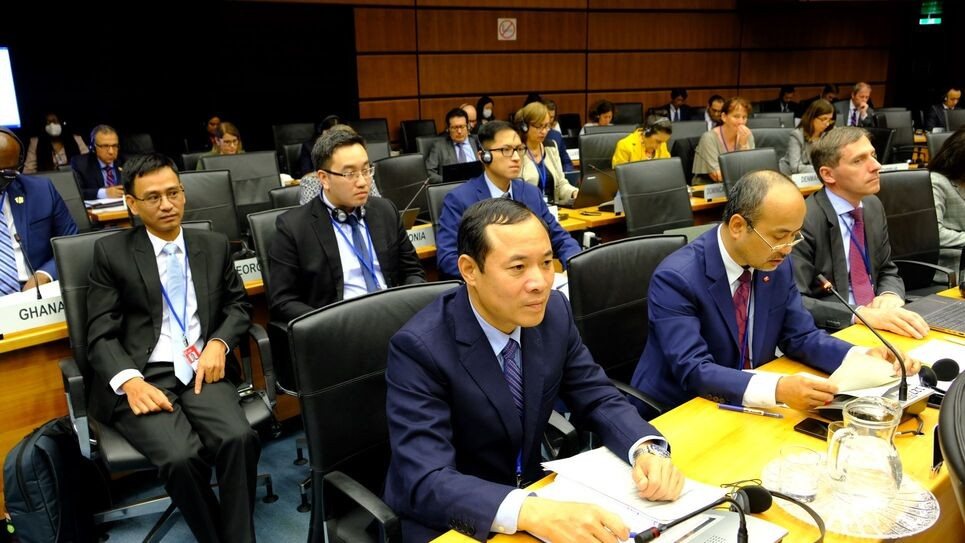
From 6 to 10 June 2022, in Vienna (Republic of Austria), the Board of Governors of the International Atomic Energy Agency (IAEA) held a regular meeting attended by representatives of its 35 member States, as well as IAEA Member States and international organisations as observers.
The Vietnamese delegation was headed by Ambassador Nguyen Trung Kien, Governor and Permanent Representative of Vietnam to the IAEA, and included Nguyen Dinh Hien, Deputy Commander and Chief of Staff of the Chemical Corps, Ministry of National Defence, together with representatives of specialised units of the Ministry of National Defence and the Ministry of Foreign Affairs.
The meeting was chaired by Ambassador Shin Chae-hyun, Head of the Permanent Mission of the Republic of Korea and Chair of the Board of Governors. Its agenda focused on major issues such as the consideration and adoption of the IAEA Director General's 2021 reports on nuclear security, safety and safeguards and on technical cooperation; a review of the implementation of the safeguards agreements between the IAEA and Iran and the DPRK; and agreement on the agenda of the 66th session of the IAEA General Conference (September 2022).
In addition, in view of recent complex developments, this meeting of the Board of Governors also considered and discussed emerging issues such as the impact of the Russia-Ukraine conflict on nuclear safety and security, the AUKUS trilateral cooperation pact between the United States, the United Kingdom and Australia on the transfer of nuclear-powered submarines, and the possibility of a nuclear test by the DPRK.
In his opening remarks, IAEA Director General (DG) Rafael Mariano Grossi said that the COVID-19 pandemic, climate change and the energy crisis had affected the IAEA's activities in nuclear security, safety and safeguards and in technical cooperation. In particular, the Director General warned of the risks to nuclear safety and security at the Zaporizhzhia plant in Ukraine, which is under Russian control, and noted that the Ukrainian authorities had reported a loss of control over nuclear material.
Director General Grossi affirmed that over the past year the IAEA had done its utmost to carry out its functions and tasks as planned. Highlights included more than 3,000 safeguards activities in various regions and several major projects, such as the ocean plastic pollution project (NUTEC) involving 120 national laboratories, the project to address zoonotic diseases (ZODIAC), and the provision of COVID-19 testing equipment benefiting more than 30 million people worldwide. He affirmed that nuclear energy brings important benefits by providing clean energy and through its applications in efforts to reduce carbon emissions, respond to climate change, and in health and agriculture. Alongside these achievements, the IAEA Director General also expressed concern that the development of new nuclear technologies could pose challenges in terms of nuclear proliferation risks and the security and safety of nuclear infrastructure.
Speaking at the meeting, Ambassador Nguyen Trung Kien highlighted Vietnam's major guidelines and policies and its efforts to ensure nuclear safety and security and to use atomic energy for peaceful purposes and sustainable development, contributing to the fulfilment of Vietnam's international commitments. He affirmed that the issuance of Decree No. 81 of 2019 on countering the proliferation of weapons of mass destruction had created a legal framework to prevent the proliferation and proliferation financing of such weapons, and he underlined the importance of the IAEA's central role in these efforts. Together with other Member States, he also shared views and interest in the potential of new technologies such as small modular reactors (SMR), transportable nuclear power plants (TNPP) and floating nuclear power plants (FNPP), and in assessments of the challenges they pose to the international legal framework and their implications for the environment, safety and security.
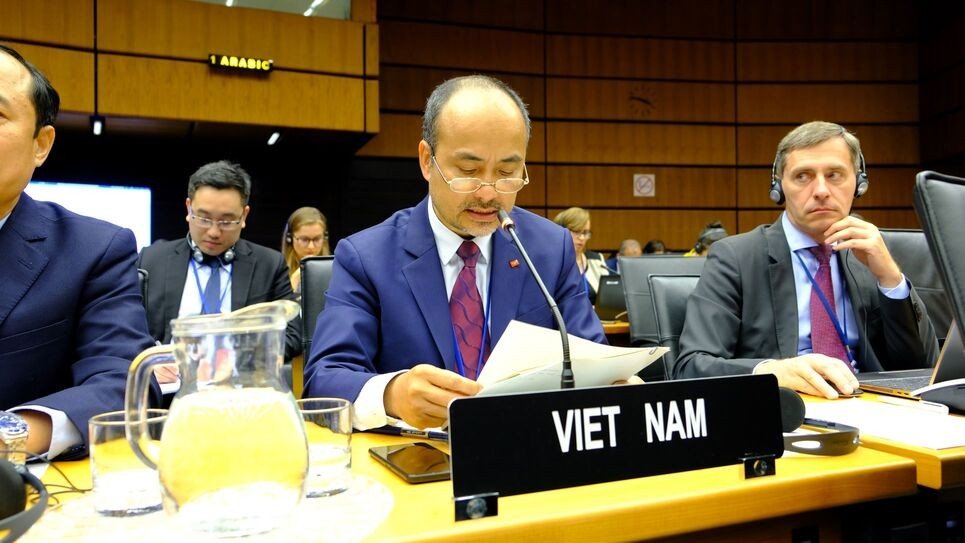
The Ambassador stressed that the research, development, licensing, operation and deployment of these new nuclear technologies should be approached in a cautious and incremental manner, and that a legal framework consistent with international law, including the 1982 United Nations Convention on the Law of the Sea (UNCLOS), should be shaped at an early stage, protecting the environment, respecting independence, sovereignty and territorial integrity, and ensuring transparency in accordance with established procedures and common practice. He also expressed support for the IAEA's leading role in this process, with the participation of Member States.
On this occasion, the Ambassador called on the IAEA to continue supporting Member States, especially developing countries, in enhancing their capacity for research and the deployment of nuclear applications and for responding to radiological and nuclear incidents, and in developing and improving their domestic legal frameworks on nuclear law.
The IAEA Board of Governors meets four times a year, in March, June, September and November. Vietnam was elected a member of the IAEA Board of Governors in September 2021 for the two-year term 2021–2023.
Cao Dang Luu
Source: Quan doi nhan dan (People's Army Newspaper)
(Read the original article here)