The negative impacts on national economies of being placed on the FATF grey list
Unofficial translation from the Vietnamese original.
The FATF recently officially placed South Africa on its “grey list”, which could have serious consequences for the South African economy, already struggling after the Covid-19 pandemic. The economic “damage” will be concentrated mainly in the financial and business sectors. South Africa is regarded as one of the financial hubs of Africa. Following a comprehensive assessment conducted at the end of 2019 and the Mutual Evaluation Report published by the Financial Action Task Force (FATF) in October 2021, South Africa failed to meet the recommended actions required by the FATF and was placed under increased monitoring (the grey list).
I) Consequences of “grey listing” for South Africa
In essence, being placed on the FATF “grey list” could threaten South Africa’s financial growth and its position as a regional leader:
1) Loss of capital inflows
According to the International Monetary Fund (IMF), countries placed on the FATF “grey list” typically suffer an average net loss of capital inflows equivalent to 7.68% of GDP. The domestic financial cost of subsequently remedying the deficiencies is also significant – combined with the fact that it usually takes two to five years for a country to be removed from the “grey list” after the mandatory requirements have been duly reviewed and accepted by the FATF. Grey-listed countries are less attractive for foreign investment, and as a result South Africa will face a contraction in foreign direct investment. Other general investment flows are also likely to decline.
2) Damage to investment and international credibility
Foreign banks and investors may become wary of doing business in South Africa, choosing instead to operate in other jurisdictions with a safer risk profile. Foreign companies wishing to do business in South Africa face increased regulatory barriers, operating costs and levels of scrutiny. Countries on the FATF “grey list” are automatically regarded by the European Union and the United Kingdom as high-risk jurisdictions (in other words, jurisdictions with strategic deficiencies in their anti-money laundering/countering the financing of terrorism (AML/CFT) regimes that pose significant threats to the financial system).
As a developed economy, South Africa will be re-rated and downgraded in global markets. However, the real impact of being placed on the FATF grey list remains to be seen.
Consider the impact on several other African countries that have been on the “grey list”, including Mozambique, Tanzania, Uganda, the Democratic Republic of the Congo, Mali, Senegal, South Sudan, Burkina Faso and Morocco. Of these, some countries recorded insignificant consequences from being grey-listed by the FATF. It could be argued that these countries appeared unaffected because of their already poor economic conditions, and because they generally do not attract the large volumes of foreign investment that South Africa does.
However, some countries have recorded significant adverse economic consequences. They often share characteristics with South Africa in certain areas: economies heavily dependent on informal cash, incomplete AML/CFT supervisory frameworks, a lack of resources in the judicial and law enforcement sectors, and unclear due diligence policies in the private and public sectors.
II) Negative impacts during Pakistan’s periods on the grey list
In contrast to South Africa, Pakistan, after facing one of the most difficult economic periods since its founding (in 1947), breathed a sigh of relief at the close of the recently convened FATF plenary meeting, when it was removed from the grey list. Experts say this has been hailed as a great diplomatic victory, bringing a range of positive implications for the economy, as it will improve investment, facilitate international lending and boost exports and imports.
This was also underlined by Pakistan’s Minister of State for Foreign Affairs, Hina Rabbani Khar, speaking to DW’s Hotspot Asia in Berlin on 17 June, on the sidelines of the FATF plenary: “No country wants to be on the grey list because it brings huge consequences, takes away investor confidence and puts a country in a difficult position.”
Pakistan has been placed on the grey list three times – in 2008, from 2012 to 2015, and from 2018 to 2022. Although the move itself does not entail sanctions, it makes the country vulnerable to being placed on the “black list”, which leads to the imposition of strict economic sanctions (currently Iran, the DPRK and Myanmar).
However, the grey list signals increased risk in dealing with the country concerned, according to The Economist Intelligence Unit. This inevitably affects exports and deters foreign investors from putting capital into the economy. “The financial sector not only faces an increased risk of sanctions but also has to raise its level of due diligence to ensure that financial transactions are legitimate. Pakistan’s economy will certainly be relieved of this burden once the country moves to the white list and complies with the FATF action plan,” said Dr Aadil Nakhoda, a member of the Economic Advisory Group of the Islamabad-based PRIME Institute, speaking to Moneycontrol.
Official data show that Pakistan’s trade deficit rose to an all-time high of US$43.33 billion in early July 2022. Foreign exchange reserves held by the State Bank of Pakistan (SBP), the country’s central bank, stood at US$8.2 billion in mid-June 2022. “Pakistan needs to improve its ability to attract investment, and being placed on the white list will certainly help at this point,” Nakhoda said.
Raja Gopal Chakraborti, Professor in the Department of South & Southeast Asian Studies at the University of Calcutta, pointed out that the consequences of FATF grey listing are also reflected in GDP growth figures. “Pakistan was off the grey list from 2015 to 2018, and its GDP growth rate was 4.7% in 2015, 5.5% in 2016, 5.6% in 2017 and 5.8% in 2018. When the grey listing was reimposed in 2018, the growth rate fell to 1.1% in 2019 and 0.5% in 2020. There is no doubt that grey listing has far-reaching effects on Pakistan’s economy,” Chakraborti told Moneycontrol.
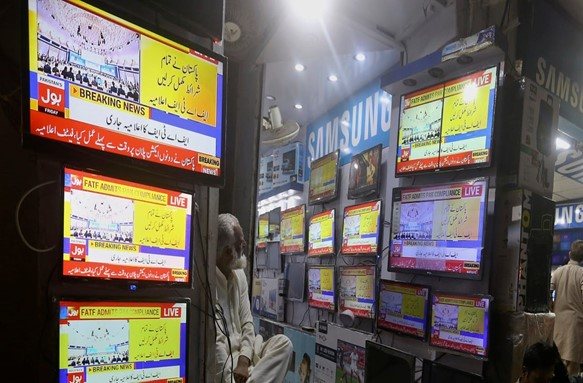 Local residents in Karachi follow news channels on 17 June, awaiting the FATF decision (AP Photo/Fareed Khan)
Estimated losses of US$38 billion
A research report published in 2020 by Tabadlab, an Islamabad-based economic think tank, stated that the grey list had caused “cumulative real GDP losses of around US$38 billion” between 2008 and 2019.
Research by Dr Naafey Sardar, an economist at the SBP, found that exports and foreign direct investment (FDI) suffered “cumulative losses of US$4.5 billion and US$3.6 billion respectively” over this period. The FATF listing from 2012 to 2015 cost the economy around US$13.43 billion. And although Pakistan came out of the FATF spotlight in June 2015, it took time for GDP to recover, with estimated losses of US$1.54 billion in 2016, the research added. This implies that FATF listing has short- and medium-term impacts on the economy.
| Fiscal year | GDP growth |
| 2015 | 4,7% |
| 2016 | 5,5% |
| 2017 | 5,6% |
| 2018 | 5,8% |
| 2019 | 1,1% |
| 2020 | 0,5% |
| Data source: World Bank | |
The research also noted that Pakistan’s removal from the grey list has at times led to a revival of the economy, as evidenced by the rise in GDP in 2017 and 2018.
Analysts say investment and exports are two of the biggest casualties of being on the FATF grey list. Exports were affected by an estimated US$1.15 billion in 2008, when Pakistan was first placed on the list, according to the research paper published by Tabadlab. In 2012, 2013 and 2014, when Pakistan was on the list for the second time, exports were affected by about US$0.5 billion, US$4.58 billion and US$0.097 billion respectively. In 2018, after being placed on the grey list for the third time, exports were affected by an estimated US$1.68 billion, followed by a loss of approximately US$1.20 billion in 2019, the report added.
Similarly, investment in Pakistan has remained low since 2008, even as other South Asian countries have been able to attract significantly higher FDI inflows. The country recorded its highest inflows in 2007, a year before it was first grey-listed, with cumulative investment that year of US$5.59 billion, or 3.67% of that year’s GDP. In 2008 it fell to US$5.44 billion and continued to slide further, with annual investment falling to US$1.67 billion in 2015, according to data shared by MacroTrends.
In 2016, a year after it was moved to the white list, investment rose to US$2.58 billion, according to MacroTrends data. It remained above US$2.50 billion in 2017 before falling to US$1.74 billion in 2018, when Pakistan was grey-listed for the third time.
Analysts expect Pakistan’s investment inflows and exports to improve once the FATF removes it from the grey list, as the country will be better integrated into global financial markets. However, the positive impact may be delayed by the ongoing global inflation following the Covid-19 pandemic.
Access to “bailout” packages
Experts say Pakistan, with mounting external debt of more than US$90 billion, is in urgent need of enhanced lending instruments. However, efforts to secure bailout packages have been constrained by the grey list. The World Bank and the International Monetary Fund (IMF), two of the world’s largest lenders, are attached to the FATF as observers. They have called for strict compliance with the watchdog’s anti-money laundering and countering the financing of terrorism (AML/CFT) measures as a condition for extending loans. The US$6 billion “bailout” secured by Pakistan from the IMF in 2019 came with a commitment to comply with the actions set by the FATF for the Government of Pakistan in 2018.
“IMF assistance is very important; however, Pakistan must also consider other multilateral lenders, improve the ease of doing business and introduce investment-friendly policies to ensure better dollar inflows. Therefore, being placed on the white list can be an important step if it improves the confidence of foreign investors,” Nakhoda said.
Pakistan received a US$6 billion bailout package from the IMF in July 2019
Centre 81 - Thanh Tung