Philippine President revamps AML/CTF strategy to take the country off the FATF grey list
Unofficial translation from the Vietnamese original.
Philippine President Ferdinand R. Marcos Jr. recently directed government agencies and departments to implement a new anti-money laundering and counter-terrorist financing (AML/CTF) strategy. The new plan aims to take the Philippines off the grey list of the Financial Action Task Force (FATF). The country was placed back on the grey list in 2021 because of deficiencies in its existing AML/CTF regime. Despite progress in key areas, the Philippines was still not removed from the grey list after the FATF Plenary in June 2023.
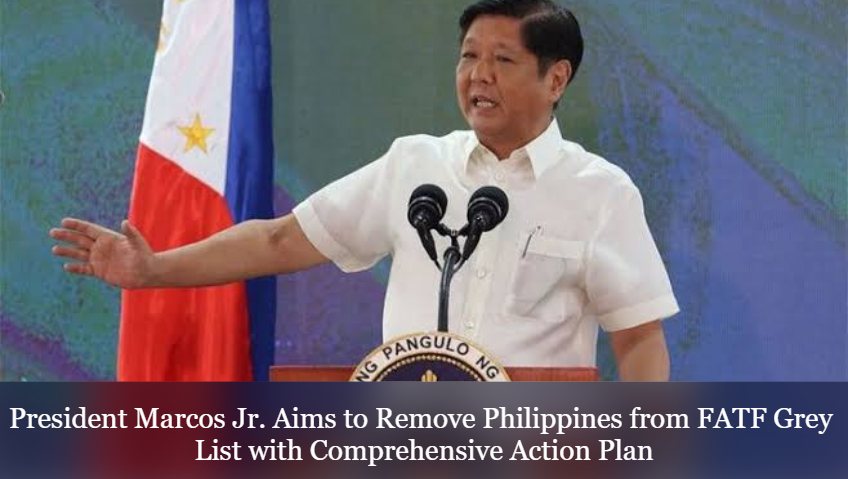
President Marcos explained that he intends to strengthen the country’s AML/CTF regime through the National Anti-Money Laundering, Counter-Terrorism Financing and Counter-Proliferation Financing Strategy (NACS) for 2023-2027. According to Marcos, the Government will soon reorganise the National AML/CTF Coordinating Committee to achieve the objectives of the NACS. To make its authority and functions comprehensive, the Committee will be renamed the National Anti-Money Laundering/Counter-Terrorism Financing/Counter-Proliferation Financing Coordinating Committee (NACC).
History and development of the AML/CTF regime in the Philippines:
The Philippines enacted the Anti-Money Laundering Act in 2001 to prevent the laundering of money derived from illegal activities. It demonstrated the country’s commitment to cooperating with international AML investigations and to punishing terrorist financing and the financing of the proliferation of weapons of mass destruction. However, following its 2009 Mutual Evaluation Report (MER), the FATF identified that many strategic deficiencies remained in the Philippines’ AML/CTF framework.
Between 2010 – when the National Action Plan was issued – and the second Mutual Evaluation Report in 2019, the Philippines’ progress was recorded against the FATF Recommendations. By June 2013, the global watchdog recognised that the country had completed its National Action Plan and established a number of necessary frameworks. However, gaps remained, for example in the casino sector, …
In October 2019, the FATF’s updated Mutual Evaluation Report identified a number of strategic deficiencies in the Philippines’ AML/CTF/PF regime. These issues arose despite the establishment of the National AML/CTF Coordinating Committee (under Executive Order 68) in 2018. The FATF set out 17 priority recommended actions to address these deficiencies. Among them, it specifically required the Philippines to implement targeted financial sanctions without delay against the financing of the proliferation of weapons of mass destruction.
Following the August 2020 assessment, many strategic deficiencies remained unresolved. In June 2021, the FATF once again added the Philippines to its list of Jurisdictions under Increased Monitoring, also known as the grey list. The regional watchdog required the Philippines to draw up a specific action plan to address its AML/CTF gaps, with progress to be assessed on site to determine whether the country qualified for removal from the grey list. By February 2023, the FATF announced that the Philippines’ action plan had expired with many deficiencies outstanding. These deficiencies included: (i) the objectives and action plan of the National AML/CTF/PF Coordinating Committee (NACC) had not been completed – specifically, the NACC’s objectives focused on drugs and corruption and therefore did not fully reflect financial crime risks; (ii) inadequate measures for prosecuting terrorist financing (TF) – the authorities focused excessively on prosecuting the predicate offences of TF while neglecting terrorist financing offences; (iii) the absence of a legal framework for implementing targeted financial sanctions (TFS) against the financing of the proliferation of weapons of mass destruction.
The path off the grey list – the Philippines’ new AML/CTF strategy
Under Executive Order 33, the Philippines has adopted a new strategy to address these deficiencies. It amends Executive Order 68 and contains three core additions: (i) revising the expired NACS for the 2018-2022 period – the Government has renamed the NACS, realigned it and added counter-proliferation financing (CPF) measures, meeting an urgent requirement set by the FATF; (ii) restructuring the NACC and granting it new authority – the Government has added the National Intelligence Coordinating Agency (NICA) as a member of the NACC. This move meets the FATF’s requirement to strengthen financial intelligence in support of AML/CTF law enforcement investigations. The NACC has also been given additional powers to help agencies implement the new AML/CTF/CPF strategy; the Committee is now empowered to set up its own support sub-committees; (iii) reorganising the Sub-Committee on Counter-Terrorism Financing and Counter-Proliferation Financing – to support the expanded focus on CPF, the Government has split this sub-committee into a Sub-Committee on Counter-Terrorism Financing and a Sub-Committee on Counter-Proliferation Financing.
These additions respond to the FATF’s priority actions in the 2019 Mutual Evaluation Report, including: (i) strengthening financial intelligence to support law enforcement investigations into money laundering, terrorist financing and predicate offences; (ii) continuing to implement the national AML/CTF strategy, ensuring the effective operation of the NACC and its sub-committees; (iii) creating a legal framework for the timely implementation of targeted financial sanctions against the financing of the proliferation of weapons of mass destruction, and for monitoring and enforcing compliance. A strengthened and reinforced AML/CTF framework will put the Philippines in a better position to address all 17 of the FATF’s recommended actions.
As the national AML/CTF framework is reorganised and expanded, firms must comply with the latest applicable legislation. Sectors that were previously unregulated or where enforcement was limited, particularly in high-risk areas, are likely to face new and more stringent requirements. Firms should therefore refine their risk assessment methodologies to manage the operational risks of their businesses. Proactive approaches are the best way to deal with financial crime.
Thanh Tung - Centre 81 (translation)
Source: (https://complyadvantage.com/insights/philippines-president-revamps-aml-ctf-strategy-to-exit-fatf-greylist/)